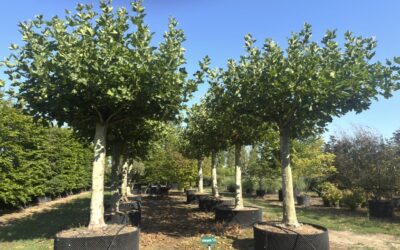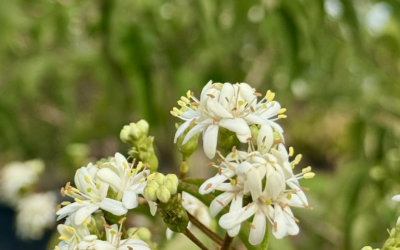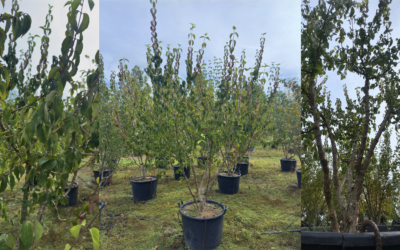
Multi-trunk trees
Description
Multi-trunked trees grow from multiple trunks and have a natural, distinctive appearance. When advising on plant and tree selection, they are often recommended if you want to create an organic, natural atmosphere without a single dominant trunk.
Application
You can plant multi-trunked trees as focal points in a garden, or in groups in parks or public spaces. They are often used in settings where structure and ambiance need to go hand in hand.
Benefits
- Multi-stemmed trees enhance biodiversity and landscape quality
- Multi-trunk trees quickly create a mature look
Ornamental shrubs
Description
Ornamental shrubs branch out from the base and add color, texture, and movement to a landscape design. They form an important intermediate layer between trees and perennials.
Application
Ornamental shrubs are ideal for formal planting, hedges, or as focal points. Advice on choosing plants and trees can help you determine which varieties are best suited to your soil and light conditions.
Benefits
Ornamental shrubs enhance biodiversity, provide seasonal interest, and require relatively little maintenance when chosen wisely.
Topiary trees
Description
Topiary trees are pruned into specific shapes and bring order to the space. When advising on plant and tree selection, they are often recommended for areas where structure and uniformity are desired.
Application
Topiary trees are commonly found in urban gardens, along avenues, and in formal landscapes. Advice on plant and tree selection will help you choose the right shape and species.
Benefits
Topiary trees are space-saving, elegant, and functional without compromising on style.
Hedge plants
Description
Hedge plants form dense, green screens. When advising on plant and tree selection, they play a role in providing privacy, wind protection, and spatial organization.
Application
You can use hedge plants as a property boundary or as a green border around a garden or park.
Benefits
Hedge plants provide shelter, reduce noise, and contribute to biodiversity.
Solitary trees
Description
Solitary trees stand alone and define the landscape. These trees have a significant impact on their surroundings and make a strong visual statement. That is why choosing the right location for them is very important.
Application
Solitary trees serve as focal points in gardens, parks, or squares.
Benefits
They give a place character, identity, and a sense of space.
Perennials
Description
Perennials form the ground cover in landscaping. When advising on plant and tree selection, they provide seasonal interest and ecological value.
Application
You use perennials in borders and planting beds, often in combination with trees and shrubs.
Benefits
They are sustainable, promote biodiversity, and require relatively little maintenance.
Evergreen plants
Description
Evergreen plants retain their leaves all year round. They provide a solid foundation when advising on plant and tree selection.
Application
They are suitable for use as hedges, ground cover, or as standalone plants.
Benefits
They provide structure, privacy, and shelter all year round.
Street trees
Description
Street trees have straight trunks and symmetrical crowns. When it comes to selecting plants and trees, the focus here is on uniformity and sustainability.
Application
You’ll find them along roads, avenues, and residential streets.
Benefits
Street trees provide shade, help keep the area cool, and create a recognizable green landscape.
Woodlands and hedgerows
Description
Woodland and hedgerow plantings consist of groups of young trees and shrubs. According to the recommendation, this is ideal for natural, hardy vegetation.
Application
You can use it in parks, green spaces, and transitional areas.
Benefits
It promotes biodiversity, reduces wind and noise, and requires little maintenance over the long term.
Practical considerations
Soil and Water
Advice on choosing plants and trees starts with the soil. Sandy soil requires different species than clay or peat. Water availability is just as important.
Space and Growth
Many people underestimate how big trees can grow. Profigreen helps you choose the right size.
Maintenance
Some types require intensive care, while others require very little. Good advice takes this into account.
Coherence and the Future
Green as a system
Profigreen views your garden or project as a living system. Every decision affects the whole.
Thinking long-term
Good landscaping is an investment in the future. Advice on choosing plants and trees ensures that you make choices today with tomorrow in mind.
Concluding Remarks
Advice on choosing plants and trees is ultimately a dialogue between people and the landscape. It involves listening to the site, understanding natural processes, and making informed decisions. Those who take this step seriously are not simply creating a garden or a landscaping project, but a living environment.
If you're looking for professional advice on choosing plants and trees, Profigreen can help you with its expertise, quality, and a wide selection to suit any project.