Heptacodium miconioides is a remarkable choice for anyone looking for a tree or large shrub that really comes into its own at the end of summer. While many other species have already passed their peak blooming period by then, Heptacodium miconioides begins to bloom spectacularly. The small white flowers appear in large numbers and are later followed by sepals that turn red. As a result, the plant remains interesting well into the fall.
This makes Heptacodium miconioides appealing not only for private gardens but also for landscape architects, gardeners, and designers of larger green spaces. The species combines long-lasting ornamental value with a relatively natural appearance. Moreover, the plant offers more than just flowers; its distinctive bark, growth habit, and dark green foliage also contribute to its overall appeal.
Therefore, if you plant Heptacodium miconioides in the right spot, you won’t end up with a tree that stands out for only a few weeks a year. It is precisely the succession of different characteristics that makes this species so interesting.
What is Heptacodium miconioides?
Heptacodium miconioides belongs to the honeysuckle family, the Caprifoliaceae. The species is native to China, where it grows in a temperate climate. Botanically speaking, Heptacodium miconioides can grow as a large shrub or a small tree.
The plant has an upright and somewhat bushy growth habit. Depending on its location, pruning, and growing conditions, Heptacodium miconioides can eventually reach a height of several meters. This places the species in an interesting size category. The tree can develop enough volume to provide real structure to a garden or landscaping project, without immediately reaching the scale of a large avenue tree.
This makes Heptacodium miconioides suitable, among other things, as a specimen tree, as part of a larger planting, or as a striking feature in a garden design.
A species native to China
The natural range of Heptacodium miconioides is in China. There, the species is known to occur in the provinces of Hubei, Anhui, and Zhejiang, among others. In Europe, the plant is primarily cultivated for its ornamental value and unique flowering period.
An interesting detail is that, according to the current botanical classification, the genus Heptacodium comprises only one accepted species. Heptacodium miconioides thus occupies a rather unique position within the plant kingdom.
Its late blooming makes Heptacodium miconioides special
The most striking feature of Heptacodium miconioides is undoubtedly its flowering period. Starting in late summer, the plant produces large numbers of small, creamy-white flowers. These flowers also have a pleasant fragrance.
That timing is important. In August and September, the number of flowering woody plants in many gardens gradually decreases. Heptacodium miconioides, on the other hand, begins to make its presence felt more prominently.
As a result, the tree can play an important role in designs that need to offer something of interest for as much of the year as possible. While spring-flowering trees attract attention mainly in April and May, Heptacodium miconioides provides a focal point much later in the season.
This late blooming can also be beneficial for pollinating insects. The flowers attract pollinators at a time when the number of flowering plants is gradually decreasing.
After the white flowers come the red ones
Its ornamental value doesn't end when the white flowers fade. After blooming, the sepals remain on the plant. They may grow larger and turn a striking shade of red to pinkish.
From a distance, this can give the impression that Heptacodium miconioides is blooming again, but this time in a different color. At first, the white flowers dominate the view, after which reddish hues take over.
It is precisely this transition that makes Heptacodium miconioides an interesting choice for a garden where the experience of the seasons plays an important role. The plant undergoes a visible transformation as fall approaches.
The bark of Heptacodium miconioides is also striking
Judging a tree or large shrub solely by its flowers does not do Heptacodium miconioides justice. As the plant ages, its bark also takes on more and more character.
The bark may peel off in yellowish-brown to brownish strips. This can create an attractive appearance, especially on trees grown as multi-trunked specimens.
Furthermore, when the lower branches are deliberately removed, the trunks become more prominent. This allows you to give Heptacodium miconioides a more distinct tree shape.
This is of interest for modern garden designs. In such designs, there is often a preference for trees that contribute to the overall look not only with their crowns but also with their trunk structure. For example, a multi-trunked Heptacodium miconioides can be combined with low-growing perennials, ornamental grasses, or a low-growing groundcover, so that its distinctive trunks remain visible.
What kind of location does Heptacodium miconioides need?
Heptacodium miconioides is not a plant that requires only one very specific type of soil. The species can grow in various soil types, provided the soil is sufficiently well-drained.
A location in full sun or light partial shade is generally suitable. For optimal growth, reasonably fertile and well-drained soil is preferred.
Heptacodium miconioides can be used, among other things, for
- sandy soil
- loamy soil
- clay soil
- calcareous soil
More important than the exact soil type is ensuring that excess water can drain away sufficiently. Soil that remains wet for a long time is different from soil that retains sufficient moisture but also drains well.
Sunlight promotes flowering
If you’re choosing Heptacodium miconioides primarily for its abundant blooms, a sunny location is the obvious choice. Light partial shade is also possible.
It is also wise to take into account the plant’s eventual size. Heptacodium miconioides is not a small border shrub. This species needs space to develop its natural crown.
A common mistake with trees and large shrubs is focusing primarily on their size at the time of purchase. For a sustainable design, however, their mature size should be the guiding factor. By setting aside enough space from the start, Heptacodium miconioides can develop without requiring constant heavy pruning later on.
Heptacodium miconioides as a multi-trunked tree
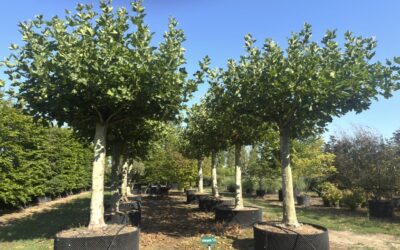
One of the most appealing uses of Heptacodium miconioides is as a multi-trunked tree. In this form, multiple trunks grow upward from a relatively low point. This creates a more open and natural silhouette than that of a traditional tree with a single straight trunk.
This shape is appealing for modern gardens because a multi-stemmed tree can provide structure without immediately appearing heavy or bulky. You can still see through the canopy, while the plant clearly adds height and volume to the design.
The combination of trunks, peeling bark, green leaves, white flowers, and sepals that later turn red causes Heptacodium miconioides to change its appearance over the course of several seasons.
An interesting choice for smaller gardens
Not every garden has room for a large tree. Yet it is precisely in smaller gardens that there is a need for vertical structure. A garden consisting solely of low-growing plants can quickly appear flat.
Heptacodium miconioides can offer an interesting compromise in such a situation. The species can eventually grow into a substantial shrub or small tree, but remains significantly smaller than many traditional park and avenue trees.
According to the Royal Horticultural Society, Heptacodium miconioides can eventually grow to a height of about four to eight meters and a width of approximately 2.5 to four meters. The actual dimensions, of course, depend on the location, soil, pruning, and age of the plant.
That still means you need to set aside enough space. For a very small city garden, a mature Heptacodium miconioides may grow too large. In a medium-sized garden, on the other hand, this species can take center stage.
Heptacodium miconioides in Professional Landscaping Projects
Heptacodium miconioides also offers interesting possibilities for gardeners, garden designers, and landscape architects. Especially in locations where the seasonal experience is important, its late blooming can complement species that bloom primarily in the spring or early summer.
Examples include entrance areas, prestigious corporate gardens, courtyard gardens, hospitality gardens, and high-end residential projects. In such locations, Heptacodium miconioides can be used as a specimen tree or as part of a larger landscape design.
One possible design, for example, is a multi-trunked Heptacodium miconioides with a calm layer of ornamental grasses and perennials beneath it. This way, the tree remains the focal point, while the ground cover creates a sense of cohesion.
Look beyond just the blooming season
When selecting plants professionally, there is more to consider than just aesthetics. A plant species must be suited to the available space, soil type, light conditions, and the desired level of maintenance.
Heptacodium miconioides also has a number of practical characteristics. The RHS describes the species as generally not very susceptible to diseases and pests. Heavy annual pruning is also not normally necessary.
That doesn't mean that Heptacodium miconioides is automatically the right choice everywhere. A suitable growing location remains essential. In particular, sufficient space and well-drained soil deserve special attention.
Pruning Heptacodium miconioides
Heptacodium miconioides does not normally require intensive pruning. With young plants, you can focus primarily on shaping them to the desired form.
If you want a multi-trunked tree with clearly visible trunks, you can selectively remove lower side branches. This will gradually reveal more of the tree's distinctive bark.
If you allow the plant to grow into a broad shrub, it will require much less pruning to maintain its shape. Of course, you can remove any damaged, crossing, or unwanted branches.
The most important thing is to decide in advance what the final look you want to achieve is. A naturally grown Heptacodium miconioides requires different care than one used as an architectural multi-stemmed specimen in a formal garden.
A Tree for a Longer Fall
Climate-resilient and future-oriented design isn't just about finding plants that can withstand drought, heat, or rain. Biodiversity and a longer flowering period are also playing an increasingly important role.
Heptacodium miconioides can contribute to this. Its relatively late blooming extends the period during which flowers are present. This is aesthetically pleasing and can also be beneficial to insects.
Especially when Heptacodium miconioides is combined with early-blooming trees, spring bulbs, summer-blooming perennials, and late-blooming varieties, it creates a garden where the blooming season lasts much longer.
The tree does not have to stand alone. In fact, it is the combination with other species that ultimately determines the ecological and visual value of a planting plan.
Why Heptacodium miconioides Is Worth Considering
Anyone looking for a unique tree will likely end up considering well-known species such as ornamental cherries, magnolias, or dogwoods. There’s nothing wrong with that, but that’s precisely why Heptacodium miconioides can be a surprising alternative.
The strength of this species does not lie in any single characteristic. It is the combination that counts. Heptacodium miconioides features white, fragrant flowers in late summer, strikingly changing sepals in the fall, distinctive bark, and an attractive growth habit.
In addition, the plant can be used both as a shrub and as a small, multi-stemmed tree. As a result, Heptacodium miconioides is suitable for a wide range of designs, from a lush private garden to a minimalist landscaping project.
Choosing Heptacodium miconioides for Your Garden or Project
Ultimately, choosing the right tree isn't just about which species looks best in a photo. Above all, you need to consider the conditions in which the tree will have to thrive over the next several decades.
If you have a sunny or lightly shaded spot, plenty of space, and soil that doesn’t stay wet for long periods, then Heptacodium miconioides is definitely worth considering. This species really stands out, especially if you value late blooming and are looking for a tree that retains its character even outside its blooming season.
The result is a plant that takes on a different appearance throughout the season. In the summer, the green foliage forms the base. Later, white, fragrant flowers appear. Then, the sepals, which turn red, provide a second burst of color. When the foliage eventually fades, the characteristic structure of the stems and bark remains.
Heptacodium miconioides thus demonstrates that an interesting tree does not necessarily have to rely on spectacular spring blooms. Sometimes the most striking part of the season begins just when many other plants are slowly fading into the background.
If you’re looking for a Heptacodium miconioides for a private garden, a professional landscaping project, or a landscape design, Profigreen can help you select a suitable specimen. We can consider not only size and quality, but also growth habit and how the tree will ultimately fit into the design.