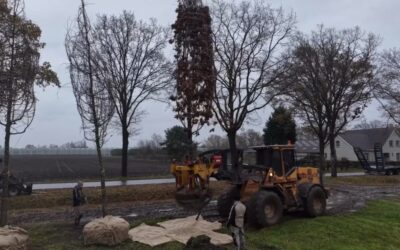
Pinus sylvestris is a tree you may know primarily from Dutch forests and heathlands, but it can also be used in surprisingly versatile ways in landscape gardens, natural green spaces, and larger private gardens. The Scots pine, as it is known in Dutch, combines a distinctive character with qualities that make it well-suited to conditions in which many other trees struggle.
This makes Pinus sylvestris an interesting choice at a time when the selection of trees is increasingly determined by soil, water availability, and climate. Longer dry spells and hot summers call for species that are not immediately dependent on nutrient-rich and permanently moist soil. At the same time, it is too simplistic to view Pinus sylvestris solely as a drought-tolerant tree. The right location remains crucial for healthy growth.
Anyone choosing a tree for the coming decades would therefore be wise to look beyond just its appearance. The key question is whether the tree is suited to the soil, the available space, and the purpose of the location.
What kind of tree is Pinus sylvestris?
A Common European Conifer
Pinus sylvestris belongs to the pine family and has a wide natural range in Europe and Asia. In the Netherlands, the species is closely associated with sandy soils, heathlands, and former drifting sand dunes. According to *Flora of the Netherlands*, the Scots pine can eventually reach a height of approximately 5 to 40 meters, depending on its location and conditions.
The tree is easily recognizable. The needles grow in pairs and are often blue-green to gray-green in color. The trunk is particularly striking on older trees. The lower part develops a darker, coarser bark, while the bark higher up in the crown can take on a warm orange to reddish-brown hue.
It is precisely this contrast that gives Pinus sylvestris its great ornamental value. A mature tree can take on an almost sculptural appearance. Especially when the tree is given enough space to grow freely, it often develops a whimsical and open crown that differs greatly from the neat shape of many traditionally planted garden trees.
This makes Pinus sylvestris not only a functional tree, but also one that allows you to consciously add character to a design.
Why Pinus sylvestris Is of Interest to Arid Regions
Well-adapted to harsh conditions
One of the most important characteristics of Pinus sylvestris is its ability to thrive in relatively dry and nutrient-poor soils. Wageningen University & Research describes the species as strongly associated with dry and moist sandy soils and notes that the Scots pine has a relatively high tolerance for drought. The species also requires plenty of light.
This makes Pinus sylvestris a good choice for higher areas of a site where water drains quickly. Examples include sandy soils, rolling landscapes, dry gardens, and locations where a traditional moisture-loving tree species would be less suitable.
That doesn’t mean that every dry soil is automatically ideal. Even a Scots pine needs sufficient water during establishment and its first few years of growth to develop a healthy root system. Extreme drought immediately after planting can cause problems even for a drought-tolerant tree.
The difference is mainly evident over the long term. Once Pinus sylvestris has become well-established and developed a suitable root system, the tree can cope relatively well with periods of low precipitation.
The Benefits of Pinus sylvestris
A strong character with relatively few demands
The appeal of Pinus sylvestris lies in its combination of sturdiness and charm. The tree does not need to be planted in the most fertile spot on a property to thrive.
A number of characteristics stand out in this regard.
- Pinus sylvestris thrives in poor, sandy soils where other large tree species have a harder time growing.
- The tree is evergreen and therefore adds structure, mass, and color to a garden or landscape even in winter.
- Older trees often develop a distinctive crown and trunk, giving each tree its own unique appearance over time.
- This species can make an interesting contribution to natural and landscape designs and fits well in plantings where a less formal look is desired.
- Due to its relatively good drought tolerance, Pinus sylvestris may be a good choice for projects in which climate-resilient vegetation plays an important role.
In this regard, the combination with other species is particularly interesting. A Scots pine does not have to be planted as part of a dense pine forest. In fact, its characteristic shape can stand out much more prominently when planted as a solitary tree or in a loose group.
Pinus sylvestris also has limitations
Not suitable for every garden and every type of soil
A strong tree is not the same as a tree that can be planted anywhere. Even with Pinus sylvestris, there are clear considerations to keep in mind.
The first thing to consider is space. A Scots pine can eventually grow into a large tree. In a small garden, this can cause problems in the long run. When planting, you should therefore consider not only the size of the tree at the time of purchase, but especially the space it will need in twenty or thirty years.
In addition, Pinus sylvestris thrives in sunlight. A dark location between buildings or under existing large trees is therefore less suitable. This species thrives best when its crown receives sufficient sunlight.
Even very wet soils and soils that remain poorly drained for long periods are not automatically suitable. Although the Scots pine occurs naturally under a wide range of conditions, its strength for many landscaping projects lies precisely in well-drained, sandy soils.
Another practical consideration is its natural appearance. Anyone looking to create a strictly formal garden with neatly shaped canopies and symmetrical structures will not always choose Pinus sylvestris. The erratic growth that makes the tree so attractive in later life actually calls for room for individuality.
Pinus sylvestris in a landscape garden
A tree that becomes more interesting as the years go by
Pinus sylvestris can be particularly effective in landscape design. The tree has a natural appearance that blends well with grasses, shrubs, heath-like vegetation, and other trees with a natural silhouette.
For example, a solitary Scots pine on an open lawn can serve as a striking landmark. A small group of Pinus sylvestris, on the other hand, can create a sense of height and depth without immediately giving the impression of a dense forest.
The tree can also be a good choice for larger gardens surrounding rural homes, estates, recreational areas, and equestrian facilities. Its evergreen crown provides visual structure throughout the year. At the same time, a mature specimen can offer shelter and shade.
You’ll need to carefully determine in advance what you want to achieve with the tree. Do you mainly want to create height, frame a line of sight, provide a natural backdrop, or perhaps plant a single, striking solitary tree? That function will help determine which size, shape, and position make the most sense.
An interesting tree for climate-conscious landscaping
Drought tolerance still requires a good start
Interest in species such as Pinus sylvestris is growing as designers and landowners are increasingly required to take dry summers into account. However, the term “climate-resilient” warrants some clarification.
No tree is completely independent of water. Research by Wageningen University & Research on Scots pine growing on Dutch sandy soil shows that water availability affects growth. A tree can therefore be drought-tolerant and, at the same time, grow better when sufficient soil moisture is available.
That distinction is important.
Therefore, you should not choose Pinus sylvestris with the idea that watering after planting will be unnecessary. A careful watering regimen during the initial period is essential, especially for larger planted specimens. The soil must contain sufficient moisture to allow new roots to develop, without causing prolonged waterlogging.
Only once the tree is well-established will the species' natural characteristics truly come into their own.
The right tree in the right place
Soil testing prevents disappointment
Before planting Pinus sylvestris, it is wise to assess the site as a whole. It is not just the soil type that matters. Groundwater, sunlight, available above-ground space, and future root space also determine whether a tree can develop sustainably.
Furthermore, on a large site, conditions can vary significantly within a few dozen meters. A lower-lying area may remain damp for longer, while a higher-lying sandy area dries out quickly in the summer.
That is precisely where an opportunity lies to deliberately combine different tree species.
For higher, drier areas, for example, Pinus sylvestris might be a logical choice, while you would use other species in lower-lying or wetter areas. This avoids a planting plan in which a single tree species is used everywhere, and instead creates a design that responds to the natural variations within the site.
That is both more environmentally friendly and more practical.
Pinus sylvestris as a solitary tree
Free growth strengthens character
One of the most beautiful ways to use Pinus sylvestris is as a solitary tree. In forests, the Scots pine often grows relatively straight upward because the trees compete with one another for light. A freestanding tree can develop in a very different way.
The crown gains more space and becomes wider and more irregular. Wind and light influence its shape, and over time, a distinctive silhouette can develop. Older, free-standing Scots pines, in particular, demonstrate just how ornamental this species can be.
In a modern landscape design, this can create an interesting contrast. For example, a natural Pinus sylvestris set against a tranquil understory of ornamental grasses or low perennials can have a much stronger visual impact than a large number of different tree species planted together.
Even in modern architecture, the rough form of the trunk and the open crown can provide an attractive counterbalance to sleek facades and straight lines.
Combining with Other Plants
Contrast makes the Scots pine stronger
Pinus sylvestris does not need to be used on its own. In fact, the tree can be part of a varied planting design.
When choosing companion plants, you should take the site conditions into account. On dry, sandy soil, it makes little sense to plant species around a Scots pine that require permanently moist and nutrient-rich conditions.
A more interesting option is to combine it with plants that are also suited to a relatively dry, sunny environment. Think of ornamental grasses, drought-tolerant perennials, and other trees and shrubs that can create a natural transition.
For example, with Pinus sylvestris, you can create a landscape that is not only visually appealing but also logically structured based on soil and climate.
Choosing the Right Quality of Pinus sylvestris
Form and origin deserve attention
When purchasing Pinus sylvestris, quality is a key factor. Especially if you want to use a larger tree as a focal point, not every specimen is automatically suitable.
The crown shape, trunk development, the ratio of height to width, and the quality of the root system all play a role in determining how the tree develops after planting. When planted as a specimen tree, a tree with its own unique character can actually be particularly attractive.
That is why it may be wise not to select trees based solely on drawings or measurements. By actually viewing different specimens, you’ll get a better sense of their shape and appearance.
At Profigreen, you can view various trees and planting combinations in the “ Experience Center .” According to the company’s own information, Profigreen has 15 hectares of open-field production and 4 hectares of container cultivation, and assists both professionals and private individuals in selecting trees and other plants.
Advice ultimately determines success
Look beyond just the species name
The decision to choose Pinus sylvestris isn't just about whether you like the look of the tree. A better question is whether the tree is suited to the conditions and the look you want to create in the long term.
In a sunny, relatively dry, and well-drained location, the Scots pine can be an excellent choice. The combination of evergreen foliage, drought tolerance, and a distinctive crown makes this species suitable for a wide range of landscaping applications.
In a wet, dark, or very small location, a different tree might be a wiser choice. Good landscaping advice therefore sometimes means deliberately not choosing an attractive tree.
Ultimately, that is the essence of a sustainable planting plan. You don’t just choose a tree based on how it looks today, but with an eye toward the situation that will exist in ten, twenty, or even fifty years.
Pinus sylvestris is a long-term choice
Pinus sylvestris demonstrates that robust, forward-thinking planting doesn’t have to be boring. The Scots pine combines high recognizability with a natural appearance and can play a valuable role, especially in drier, sandy locations. As the tree ages, its scenic appeal often only increases.
On the other hand, factors such as space, light, soil, and water management must be carefully assessed in advance. Even a hardy species will ultimately only thrive if the site is suitable.
If you’d like to know whether Pinus sylvestris is suitable for your garden, property, or landscaping project, Profigreen can help you assess the site and select an appropriate specimen. By working together to evaluate the soil, available space, desired appearance, and future growth, Pinus sylvestris becomes not just a random choice, but a carefully considered part of the landscape.