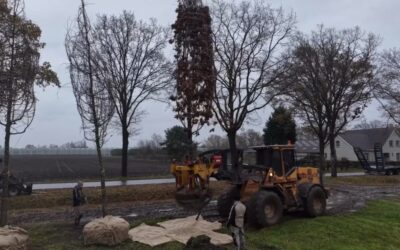
Fagus sylvatica, better known in the Netherlands as the common beech, is an interesting choice if you’re looking for a stately tree for the higher and relatively drier parts of a property. The tree is a striking feature, can live for decades, and fits well in both natural and more formal landscapes. However, a tree’s appearance alone is never a sufficient reason to choose a particular species. Ultimately, the site plays a major role in determining whether a tree can thrive.
That also plays a role in the redevelopment of Millstream, Kristy Snepvangers’ horse stable and training facilities. The grounds are undergoing a major transformation that involves not only renovating buildings and facilities but also redesigning the surrounding landscape. During her visit to Profigreen, Kristy discussed with Bas which trees are suitable for the various parts of the grounds.
It was precisely there that it became clear just how great the differences can be within a single location. Lower-lying areas retain moisture longer after rain. In higher areas, the water drains away more quickly, and the soil is generally drier. You don’t necessarily need the same trees for those different conditions.
For low-lying and moist areas, Quercus palustris, the swamp oak, emerged as a suitable option. You can read more about the characteristics and uses of this tree in our blog post on Quercus palustris as a choice for moist and low-lying soil.
In the higher and drier parts of Millstream, another species came to the forefront. There, Fagus sylvaticacan play an important role.
Why Fagus sylvatica Is of Interest to Higher Elevations
When looking at a large area, the first thing you usually notice are the visible differences in elevation. These differences are particularly important when it comes to trees. Water flows to lower-lying areas and often remains there longer. Higher ground generally drains precipitation more quickly and can therefore dry out sooner.
Fagus sylvatica thrives in well-drained soil where excess water can drain away easily. The common beech does not tolerate having its roots in water for long periods and therefore requires a different growing site than, for example, Quercus palustris.
That makes the combination of these two trees an interesting choice for a site like Millstream. Instead of planting a single tree species throughout the entire site, you can adapt the planting to the natural conditions. The swamp oak is planted where the soil remains moist for longer, while Fagus sylvatica is planted in the higher areas where drainage is better.
That sounds obvious, but in practice, when landscaping large areas, the focus is still often primarily on aesthetics. The question of which tree looks good in a particular spot is given more attention than the question of whether that tree will still be able to grow healthily there twenty years from now.
Fagus sylvatica is not a tree suited for every dry location
The term “dry soil” requires some clarification. Fagus sylvatica is suited to well-drained and relatively drier sites, but that does not mean that the common beech can grow without difficulty in extremely dry soil.
A young beech tree can actually be sensitive to prolonged drought. This is partly because a large portion of its root system develops relatively close to the soil surface. During long periods without precipitation, the topsoil can dry out quickly.
The ideal conditions for Fagus sylvatica are therefore not bone-dry sandy soil with no available moisture, but a higher, well-drained site with sufficient soil quality and moisture-retention capacity. For example, fertile loamy soil is more favorable than very poor and extremely dry sandy soil.
That distinction is important for a professional planting plan. Higher elevation does not automatically mean dry, and dry does not automatically mean suitable. Soil testing and knowledge of local water management remain essential.
At Millstream, therefore, we don’t just consider elevation differences. Soil structure, available space, and the future growth of the trees are also factored into our recommendations.
The distinctive appearance of Fagus sylvatica
In addition to its location, its appearance is an important reason to choose Fagus sylvatica. The common beech is one of the most recognizable deciduous trees in Europe and can grow into an impressive specimen.
The crown develops broadly and densely. In a mature, free-standing tree, the branches can extend far outward, making Fagus sylvatica a striking landscape feature. On a large property, a single mature tree can ultimately play a significant role in defining the landscape.
The trunk is also distinctive. The smooth, gray bark remains intact for a relatively long time and gives the tree its recognizable appearance. Especially when combined with the dense crown, it creates the classic image that many people associate with old European parks, estates, and forests.
In the spring, Fagus sylvatica sprouts fresh green leaves. Over the course of the summer, the foliage becomes darker and denser. In the fall, the leaves turn shades of yellow-brown and copper.
As a result, the tree's appearance changes noticeably with the seasons.
That’s interesting for a location like Millstream. A horse stable and training complex is primarily functional, but the surroundings play a major role in determining how the entire site is experienced. Large trees can visually connect buildings, paddocks, riding arenas, and other facilities while also giving the landscape a sense of scale.
Fagus sylvatica needs plenty of space
One of the most important considerations when planting Fagus sylvatica is the available space. A young tree may appear relatively compact when first planted, but that appearance changes as the years go by.
A mature European beech can reach a height of about 25 to 30 meters. Under favorable conditions, some trees can grow even larger. The crown can also develop to a considerable width.
That is why, when it comes to positioning, you need to look beyond the first few years after construction.
If you plant your Fagus sylvatica too close to a building, paved area, or other large trees, it could cause problems over time. On a spacious property, however, you can give the tree enough room to develop its natural crown shape.
That is an important difference between landscape design and simply filling empty spaces. A good planting plan considers what the site will look like in five years, but also what it will look like in twenty or thirty years.
The soil determines the success of Fagus sylvatica
With Fagus sylvatica, the soil requires special attention. The European beech grows best when its roots can develop properly and water does not remain pooled around the root system for long periods of time.
Compacted soil can therefore pose a problem. This occurs, for example, on sites where heavy equipment has been driven extensively during construction work. At first glance, the top layer may look normal, while deeper soil layers are heavily compacted.
This is an important consideration, especially for a site that is being renovated or redesigned, such as Millstream.
When rainwater cannot drain away adequately due to soil compaction, an area that is geographically higher may still become too wet for Fagus sylvatica. Conversely, very loose soil can drain water so quickly that young trees do not have enough moisture available during dry summers.
A good location therefore requires balance.
The following factors are particularly important for the healthy development of Fagus sylvatica
- sufficient space for roots to grow
- soil that can drain excess water
- sufficient moisture available during dry periods
- room for the future crown
- protection and additional water during the first few years after planting
It shows why simply looking at the tree species isn't enough. The conditions under which you plant the tree are just as important.
Fagus sylvatica on a horse farm
When designing an equestrian facility, there are also different considerations than when designing a garden or public park. Trees should not only be attractive but also strategically placed in relation to riding trails, paddocks, training facilities, and other areas where horses are present.
This calls for a deliberate positioning of Fagus sylvatica.
For example, a large beech tree can serve as an excellent landscape tree in spacious green belts or as part of a larger green structure. The tree can add height to the design and create a visual transition between built-up areas and the surrounding landscape.
At the same time, caution is needed when planting trees directly in or along areas where horses can graze freely or reach branches and leaves. When designing a horse facility, it is therefore always necessary to consider separately the accessibility of the vegetation, the use of the grounds, and the safety of the animals.
At Millstream, our advice isn’t just about where Fagus sylvatica can grow well. It’s just as important to consider where the tree can be responsibly placed within the context of the site’s daily use.
From Quercus palustris to Fagus sylvatica
What's interesting about Kristy Snepvangers' project is that it illustrates why professional landscaping advice almost never consists of a single, one-size-fits-all solution.
Just consider the difference between Quercus palustris and Fagus sylvatica.
Quercus palustris is well suited for use in moist and lower-lying areas. Fagus sylvatica, on the other hand, requires a well-drained site and is therefore a better choice for the higher parts of the same area.
These two species thus illustrate an important principle of landscape design: It is not the tree that determines where it will be planted. Rather, the conditions of the site determine which tree has the best chance of thriving there.
That principle can prevent many problems.
A tree that is not suited to its location may still grow reasonably well during the first few years. Problems with root development, drought stress, or persistently wet soil sometimes do not become apparent until later. By that point, a great deal of time and money has already been invested in the tree.
By carefully examining the differences within a site in advance, you can create a much more sustainable planting plan.
The common beech as a solitary tree or part of a green structure
Fagus sylvatica also offers a variety of design possibilities. The species is known as a large specimen tree, but it can also be used in groups, avenues, and other landscape features.
In addition, Fagus sylvatica is, of course, well known as a hedge plant. A beech hedge has the unique characteristic that a large portion of its withered foliage can remain on the plant throughout the winter. As a result, the hedge provides a relatively high level of visual screening even outside the growing season.
For large trees, the emphasis is instead on the development of the crown and the character of the individual tree.
On a spacious property, a solitary Fagus sylvatica can eventually become a landmark. In contrast, multiple trees can emphasize a line in the landscape or visually connect different parts of a property.
Which application works best depends on the scale and function of the location.
Be prepared for warmer and drier summers
When choosing Fagus sylvatica, it’s wise to also consider the long term. Summers in the Netherlands and Western Europe are increasingly characterized by periods of high temperatures and prolonged drought.
This is relevant for a tree that, while it does require a well-drained site, does not perform optimally under prolonged moisture deficiency.
Young Fagus sylvatica trees, in particular, therefore require special attention during dry periods. Proper preparation of the planting site, sufficient organic matter in the soil, and targeted watering can help the tree establish itself successfully.
The quality and size of the tree at the time of planting also play a role. Large trees produce immediate results, but at the same time require a larger root system to restore the balance between the crown and the roots after transplanting.
Professional planting, therefore, does not end once the tree is in the ground. In fact, the care provided during the first few years plays a major role in determining how Fagus sylvatica will ultimately develop.
Choosing the right tree starts with assessing the site
The project at Millstream shows that differences in elevation mean more than just variation in the landscape. They influence rainwater runoff, the amount of available soil moisture, and, ultimately, the choice of trees and plants.
For lower-lying and wetter areas, Quercus palustris may be a logical choice. If you’d like to learn more about this application, read our blog post on Quercus palustris for wet and low-lying soil.
In the higher, better-drained areas, Fagus sylvatica plays a more prominent role. There, the common beech combines a striking landscape presence with a long lifespan and a distinctive character.
That said, a tailored approach remains essential. Fagus sylvatica is not an automatic solution for every dry site. Soil structure, available moisture, compaction, space, and the future use of the site all determine whether the species is truly suitable.
Fagus sylvatica as part of a sustainable planting plan
Ultimately, a good planting plan doesn't start with the question of which tree you like, but with the question of what a location needs.
At Millstream, this means that differences in elevation are deliberately used to provide suitable habitats for different tree species: Quercus palustris for areas where moisture lingers longer, and Fagus sylvatica for higher zones where water drains more easily.
This not only provides more variety; above all, it increases the likelihood that the trees will grow healthily and remain part of the landscape for decades after they are planted.
If you’re considering planting Fagus sylvatica in a garden, on company grounds, at a horse farm, or for another landscaping project, it’s wise to first assess the soil and water management conditions. Profigreen can help with this. By combining an understanding of the site’s conditions with expertise in trees, growing sites, and landscape design, we create a planting plan in which every tree is placed where it can truly thrive.