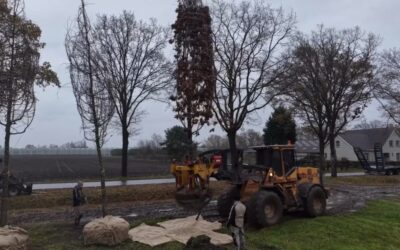
Quercus palustris: a smart choice for damp soil on your property
Not every tree thrives in moist soil. Especially on larger properties, where differences in elevation cause rainwater to pool in certain areas, choosing the right tree species is important. Quercus palustris, better known as the swamp oak, is a tree that thrives in moist soil.
This also came up during a visit by Kristy Snepvangers to Profigreen. She stopped by to get advice on the new plantings around her horse stable and training facilities Millstream. The grounds are currently undergoing extensive renovation and redesign. New trees and plants will eventually provide more greenery, structure, and a well-maintained appearance.
During the conversation with Bas from Profigreen, an important question quickly came up: What kinds of trees should you plant in areas where the soil stays moist for longer?
Not every spot on a property is the same
Anyone landscaping a larger area will almost always have to deal with variations in soil and water management. Rainwater often pools longer in lower-lying areas, while higher areas dry out more quickly.
At Millstream, this means that a single, standardized planting plan for the entire site is not the best solution. Each location requires a tree or plant that is suited to its specific conditions.
For the lower-lying and wetter areas, Bas therefore recommended, among other species, Quercus palustris. This oak thrives in moist soil, making it a good choice for areas where other tree species do not fare as well.
Why the swamp oak thrives in moist soil
The name "swamp oak" gives a clue. Quercus palustris is native to North America, where it grows naturally in moist soils and along rivers, among other places.
As a result, the tree can cope better with temporary wet conditions than many other oak species. That does not mean, however, that its roots should be permanently submerged in standing water. Even for a swamp oak, a suitable soil structure and sufficient oxygen around the roots remain important.
For a site like Millstream, that distinction is important. Some areas may remain damp for an extended period after heavy rainfall, without standing water. It is precisely in such spots that Quercus palustris can be a good choice.
In large-scale planting projects, misjudging the soil conditions can be a costly mistake. A tree may look healthy when it is planted, but if the site is not suitable for the species, problems may not become apparent until years later.
By carefully assessing elevation differences, soil conditions, and water management in advance, you increase the likelihood that trees will thrive and remain part of the landscape for many years to come.
A tree with a distinctive appearance
Quercus palustris is not chosen solely for its practical qualities. The tree also has a lot to offer in terms of its appearance.
Young swamp oaks typically have a fairly regular, pyramidal crown. As the tree ages, the crown becomes increasingly voluminous. A characteristic feature is the structure of the branches: the lower branches may grow slightly downward, while the upper branches point upward.
This gives the tree a distinctive silhouette and creates a beautiful vertical structure in the landscape.
The foliage is also striking. The leaves are deeply lobed and have pointed tips. In the fall, the foliage turns beautiful shades of warm red and brown.
This makes Quercus palustris not only a practical choice for the right location, but also a tree that enhances the landscape throughout the different seasons.
Relatively rapid growth and low maintenance
For larger projects, growth rate is also a factor. After all, you don’t want to wait decades before the new plantings become a visible part of the landscape.
Quercus palustris grows relatively quickly for an oak and can eventually grow into a large tree measuring twenty meters or more. When planting, it is therefore important to consider not only what the tree looks like today, but especially the space it will need in ten, twenty, or thirty years.
When planted in the right location, the swamp oak requires relatively little maintenance. Young trees do need extra care during their first few years, however. Additional watering may be necessary, especially during dry periods, until the root system has developed sufficiently.
The right tree in the right place
The example of Millstream clearly illustrates why a planting plan involves more than just choosing attractive trees.
On a large piece of land, conditions can vary significantly within a few dozen meters. A low-lying area may remain damp for a long time after a rainstorm, while a higher-lying area on the same piece of land dries out quickly.
That is why, when selecting trees, Profigreen considers factors such as:
the soil type, water management, elevation differences, available space, desired appearance, and the function of the plants.
For the wetter areas, Quercus palustris may be a suitable choice. For the higher and drier parts of Millstream, however, other species are more interesting. These require a different approach and will be discussed in a separate blog post.
Quercus palustris as part of a comprehensive planting plan
Of course, a tree rarely stands entirely on its own. Especially on a site like Millstream, it’s ultimately the overall picture that matters.
The swamp oak can be combined with other trees, shrubs, and perennials that also thrive in moist soil. Combining different heights, shapes, and textures creates a more natural and attractive landscape.
It is also important that the landscaping not only look attractive immediately after installation. A good design takes into account how trees and plants will develop in the coming years.
That's exactly where choosing the right variety and location makes all the difference.
A sustainable choice starts with the location
The decision to choose Quercus palustris during the consultation with Kristy Snepvangers shows how important it is to first assess the site and only then consider the tree.
For the lower-lying, moist areas of Millstream, the swamp oak offers a wonderful combination of vigor, visual appeal, and suitability for the site. Its distinctive crown, beautiful autumn colors, and relatively rapid growth also make it an attractive choice for areas where plantings must not only serve a functional purpose but also add atmosphere and structure.
Are you unsure which trees or plants are best suited for your property?
Profigreen would be happy to work with you on this. By taking into account the soil, moisture levels, elevation changes, and the desired aesthetic, we can create a planting plan that not only suits the location but will also remain effective in the long term.