Multi-trunked trees are increasingly shaping the look of gardens, parks, and streets, as they appear natural, powerful, and refined all at once. If you look closely, you’ll see that these trees aren’t just a passing trend, but a response to how we engage with space, nature, and urban life today. Multi-stemmed trees tell a story about landscape, time, and human choices, and that is precisely why they deserve more than just a fleeting glance at a garden center.
What you’ll find here isn’t just marketing talk, but a critical yet enthusiastic exploration of what multi-stemmed trees represent. Why are designers, municipalities, and private garden owners increasingly opting for this form of growth? What makes multi-stemmed trees ecologically interesting? And what should you keep in mind if you want to use them? Step by step, I’ll take you into the world of multi-stemmed trees, with an eye for both beauty and substance.
What are multi-stemmed trees?
Multiple stems, one character
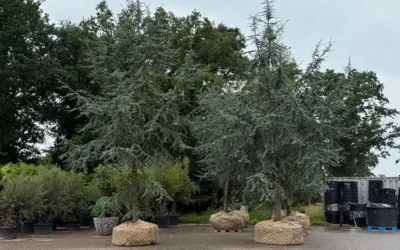
Multi-trunked trees do not grow from a single central trunk, but develop multiple trunks from the base. That simple fact makes all the difference. Whereas a traditional avenue tree often looks sleek, uniform, and almost architectural, multi-trunked trees have a more relaxed, organic appearance. The trunks bend, split, and each find their own way upward, making every multi-trunked tree unique.
Multi-trunked trees can be seen as a hybrid between a large ornamental shrub and a solitary tree. They have the height and visual impact of a tree, but the layered structure and dynamic quality of a shrub. This combination makes multi-trunked trees particularly appealing in contemporary landscape design, where natural forms are increasingly valued.
It’s also important to note that multi-trunk trees often have a mature appearance even at a young age. Because they have multiple trunks, they fill the space more quickly and appear less fragile than a young single-trunk tree. For those who want to add atmosphere to their garden right away, multi-trunk trees are therefore a logical choice.
Why you're seeing them more and more often
A response to urbanization
You’re seeing multi-trunked trees more and more often in places where space is limited. In compact urban gardens, new residential developments, and redesigned public squares, multi-trunked trees offer a way to add greenery without a single massive canopy dominating the space. Multi-trunked trees spread out their presence and therefore feel more approachable.
At the same time, multi-stemmed trees fit well with the current preference for natural landscaping. Neat hedges and perfectly symmetrical trees are slowly giving way to landscaping that resembles what you might find in the wild. Multi-stemmed trees fit seamlessly into this trend.
There’s another factor to consider. Multi-trunked trees are visually appealing in every season. In the spring, they display fresh foliage; in the summer, they provide light shade; in the fall, their leaves often turn spectacular colors; and in the winter, their branched structure remains visible. Even without leaves, multi-trunked trees remain a decorative feature.
Applications in gardens, parks, and cities
From solitary plants to group plantings
Multi-trunk trees are incredibly versatile. In a garden, you can plant them as focal points, where they immediately catch the eye. Multi-trunk trees add character to a patio, define a line of sight, or create a smooth transition between the house and the garden.
In parks and public spaces, multi-trunk trees are often planted in groups. Placing several multi-trunk trees together creates a layered, almost wooded effect. This works well along paths, playgrounds, or water features.
In urban environments, multi-trunk trees serve as a softening element between buildings, asphalt, and concrete. They break up hard lines, provide shade, and make spaces more pleasant to spend time in. More and more cities are discovering that multi-trunk trees are not only beautiful but also contribute to quality of life.
Ecology and Climate
Multi-stemmed trees as allies
You cannot view multi-trunked trees in isolation from their ecological role. Thanks to their spreading growth habit, multi-trunked trees provide shelter for birds, insects, and small mammals. The space between the trunks creates microclimates where animals can take refuge and nest.
Multi-stemmed trees also contribute to biodiversity. Many species of multi-stemmed trees produce flowers, berries, or seeds that provide food for wildlife. At a time when insect populations are under pressure, multi-stemmed trees are a valuable addition to our green spaces.
Multi-stemmed trees also play a role in climate adaptation. They provide shade, reduce heat stress, and help absorb water during heavy rainstorms. Multi-stemmed trees are therefore not only aesthetically pleasing but also functional in a changing climate.
Design and Aesthetics
Shape, texture, and space
When incorporating multi-trunked trees into a design, you need to consider not only height but also volume and transparency. Multi-trunked trees create a layered effect, allowing you to see partially through the trunk structure. This makes them ideal for areas where you want greenery but not a completely enclosed screen.
Multi-trunked trees blend beautifully with other plants. They create a natural transition between low-growing perennials, ornamental shrubs, and taller trees. In a well-designed garden, multi-trunked trees enhance the cohesion between different green elements.
You can also use multi-trunked trees to set the mood. A multi-trunked Japanese flowering cherry creates a soft, poetic atmosphere, while a multi-trunked oak conveys strength and stability. The choice of a particular type of multi-trunked tree therefore has a significant impact on the character of a space.
Maintenance and Management
What does a multi-trunked tree require?
There is sometimes a misconception that multi-trunked trees require little maintenance. That is not entirely true. In fact, multi-trunked trees require careful guidance, especially in the early stages. You need to pay attention to the balance between the different trunks, so that one trunk does not dominate all the growth.
Pruning multi-stemmed trees is more a matter of guiding their growth than of drastic intervention. The goal is to preserve their natural shape while ensuring their health and stability. Proper care ensures that multi-stemmed trees remain attractive for many years.
Placement is also crucial. Multi-trunk trees need space to grow. If you plant them too close to a wall or fence, they may not be able to develop properly. So be sure to consider the eventual size of multi-trunk trees carefully beforehand.
Multi-stem trees in the Profigreen range
Description
Multi-stemmed trees occupy a prominent place in Profigreen’s product range. Here, multi-stemmed trees are viewed as fully-fledged structural elements in gardens and public spaces, rather than as a byproduct of traditional tree cultivation. The multi-stemmed trees offered by Profigreen are selected for their quality, form, and vitality.
These multi-trunk trees are carefully cultivated so that they make an immediate impact from the moment they are planted. You won’t receive a fragile young plant, but a well-developed multi-trunk tree that instantly enhances the appearance of your project.
Application
Profigreen's multi-trunk trees are suitable for a wide range of applications. They can be used as focal points in private gardens, as part of a park design, or as green accents in urban projects. Multi-trunk trees fit seamlessly into both natural landscapes and modern outdoor spaces.
In addition, multi-stemmed trees pair well with other elements in the collection. Consider ornamental shrubs, perennials, or evergreens, which, when combined with multi-stemmed trees, create a cohesive whole. In this sense, multi-stemmed trees are not isolated elements, but rather a connecting link in a larger landscaping concept.
Benefits
- Multi-trunk trees immediately give a mature and natural look
- Multi-stemmed trees enhance biodiversity and landscape quality
These benefits make it clear why multi-trunk trees are so popular among both professionals and homeowners. They combine beauty with functionality, a factor that is becoming increasingly important in contemporary landscape design.
A broader view of green spaces
Multi-trunked trees in relation to other vegetation
Although this article focuses on multi-stemmed trees, they never stand alone. In a comprehensive landscaping plan, topiary trees, hedge plants, solitary trees, perennials, and avenue trees also play a role. Multi-stemmed trees often serve as a bridge between these different categories.
While topiary trees provide a sense of order and structure, multi-stemmed trees bring softness and variety. While avenue trees create rhythm along roads, multi-stemmed trees add character to squares and parks. In this sense, multi-stemmed trees are an indispensable part of a diverse green landscape.
Concluding Remarks
Why multi-stemmed trees matter
When you think about the future of our living environment, you can’t ignore multi-stemmed trees. They symbolize a shift from a rigid, controlled approach to nature toward a more organic, resilient one. Multi-stemmed trees aren’t just a trend; they’re an expression of how we want to interact with space and greenery in a different way.
They offer beauty, ecological value, and a sense of place. They invite us to look, feel, and experience, rather than simply pass by. In a world that is becoming increasingly crowded and urbanized, multi-trunked trees give us back a sense of natural tranquility.
If you’d like to incorporate multi-trunk trees into your garden or project, Profigreen can help you with expert advice, high-quality products, and a wide selection.